Stipulating pilot skill evaluation and operation standards for each model, evaluating safety from both human and operational aspects To establish a new "drone operator skill and operation certificate by model" - Four domestic drone aircraft manufacturers participate, accelerating the social implementation of drones -
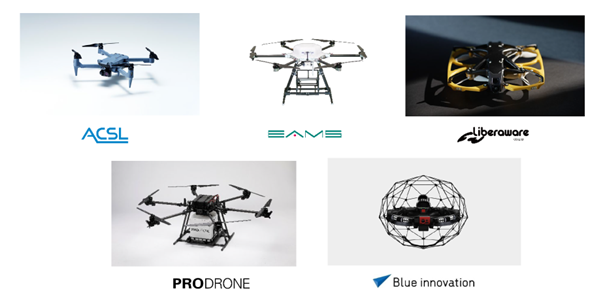
The Japan UAS Industry Promotion Council (Secretariat: Bunkyo-ku, Tokyo, Chairman: Shinji Suzuki, hereinafter referred to as JUIDA) and Blue Innovation Co., Ltd. (Headquarters: Bunkyo-ku, Tokyo, Representative Director and President: Takayuki Kumada) are jointly operating ACSL Co., Ltd. (Headquarters: Edogawa-ku, Tokyo, Representative Director and CEO: Washiya) Satoshi, hereinafter referred to as ACSL), Eames Robotics Co., Ltd. (Headquarters: Minamisoma City, Fukushima Prefecture, President and Representative Director Eiji Soya, hereinafter referred to as Eames Robotics), Liberaware Co., Ltd. (Headquarters: Chiba City, Chiba Prefecture, Representative Director and CEO Hirokei Min, hereinafter referred to as Liberaware), Prodrone Co., Ltd. (Headquarters: Nagoya City, Aichi Prefecture, Representative Director and President Toya) We have entered into a strategic partnership MOU with Shunsuke (hereinafter referred to as "Prodrone") to establish a new "Drone Operator Skills and Operation Certificate by Model" (hereinafter referred to as "License by Model") that objectively evaluates and certifies that a drone pilot has the operating skills and safe operation skills for each type of drone sold in Japan.
Additionally, in addition to the domestic drone manufacturers mentioned above, several domestic distributors of overseas drone manufacturers have announced their participation in this initiative.
Background to the conclusion of the MOU - Towards resolving human operations issues -
Current skill certifications at drone schools, etc. do not actively evaluate skills for aircraft other than those used in the course, so when actually operating a drone, training is required to become familiar with the aircraft being handled. On the other hand, in conventional training, the manuals and training content for drones vary depending on the manufacturer, so there were issues with risk assessment and risk control when handling a new model or when the model being handled changed. For this reason, the implementation of drone operations is biased towards specific drone pilots who are highly skilled in both operation and safety management, creating the issue of a shortage of drone pilots as demand for drone operations increases.
Furthermore, there are few training courses using domestically produced aircraft at drone schools, etc., which has created a barrier to using various domestically produced aircraft when actually operating drones.■Challenges in drone operation・The instructions and training for how to handle the aircraft are completely different depending on the manufacturer, making it difficult to operate a model from another manufacturer.
・Even when outsourcing, there are no standards for objectively evaluating the extent to which the outsourced drone pilots have knowledge and skills regarding the aircraft they handle, and operational tasks are concentrated on a few highly skilled drone pilots.
・There have been cases where drone pilots who are accustomed to using aircraft made by foreign manufacturers operate domestically produced aircraft with little experience, without fully understanding the operability, and are unable to fully demonstrate its performance.
Future initiatives - Achieving both safe operation and market expansion -
By signing this MOU, JUIDA, Blue Innovation, and the aircraft manufacturers will jointly promote the following in order to resolve the issues mentioned above.■Standardizing safety and establishing an objective evaluation system・Development of pilot/operation skill programs and evaluation standard guidelines for each drone type
・Continuously guaranteeing the technical level of drone pilots through unified training for each model and periodic tests
・Issuance of certified licenses for each model and establishment of drone pilot skill management methods■Creating new business opportunities and improving industry credibility・Building an industry business scheme to introduce and expand the use of drones
・Various proposals to the national and local governments, etc. toward the de jure standardization of licenses for each model
Through this initiative, we will continue to improve the safety, reliability, and professionalism of the drone industry, significantly reduce the risk of accidents by preventing operational errors in drone operational applications (inspection, logistics, surveying, etc.) and becoming familiar with emergency procedures, and ultimately contribute to the sustainable growth and social acceptance of the industry as a whole.
In addition, in this initiative, we will collaborate with various projects promoted by the Ministry of Economy, Trade and Industry, NEDO, etc., and consider the advancement and development of the drone industry, the establishment of new standards for safe and efficient drone operation, and the utilization of new technologies.
Role of each company
■JUIDA
・Development of model-specific training programs and evaluation standard guidelines
・Development and issuance of drone operator skill/operation certificates by model
・Regular implementation of instructor training and pilot training by aircraft type at JUIDA certified schools
■Blue Innovation
・Development and operation of license acquisition pilot management system
・Planning and consideration of flight simulators by aircraft type
・Building and operating a scheme to promote the introduction of aircraft
■Each aircraft manufacturer
・Preparation and provision of manuals for each model and development support for model-specific education programs
・Drone pilot training and license dissemination activities when selling our own aircraft
・Building and operating a scheme to promote the introduction of aircraft
Comments from representatives of each company
JUIDA Chairman Shinji Suzuki
JUIDA aims to contribute to the healthy development of the unmanned aircraft industry, and since its establishment, JUIDA has promoted the development of human resources with the skills and knowledge necessary for drone operations, the formulation of rules and standards, and research and development to improve safety. Through this initiative, we will continue to realize safe and secure drone operations, expand domestic demand for drones, and ultimately promote the social implementation of drones.
Blue Innovation Representative Director and President Takayuki Kumada
By unifying drone operating standards and pilot skill evaluations, the safety and objectivity of drone operations will be ensured, allowing orderers to entrust operations to license holders with peace of mind, and contractors can also expect to see more opportunities for outsourcing work. Through this initiative, we will contribute to the expansion of the drone industry market and, by extension, the revitalization of the industry as a whole.
ACSL Representative Director and CEO Satoshi Washitani
With the lifting of the "Level 4" and "Level 3.5" regulations, the Japanese drone market is entering a new phase. Under these circumstances, as a leading company of domestically produced drones that currently has the only aircraft in Japan that has obtained "Type 1 Type Certification" and a track record of "Level 4", we will work to create safe and secure aircraft options and user value through this alliance.
Eames Robotics President and Representative Director Eiji Soya
In parallel with our efforts to create highly safe aircraft that can obtain type certification, which we are taking the lead in, we believe that it is necessary to evaluate the skills of operators and standardize operational standards in order to implement these aircraft in society. I would like to lead to the implementation of drones throughout the industry.
Liberaware CEO Hongkyu Min
Our company will contribute to this collaboration with our high-precision small industrial drone technology that makes full use of cutting-edge technology. By combining autonomous flight and large-scale data analysis, we aim to explore new possibilities for the use of drones and use them in various fields such as infrastructure inspections and disaster response. Through this collaboration, we hope to foster growth across the industry and help create a safe and efficient future.
Prodrone Representative Director and President Shunsuke Totani
We believe that this license system is important as drones become more popular. We believe that there will be more opportunities for more people to use our aircraft, and that the industrial use of drones will proceed safely. We hope that this license system will be able to contribute to the spread of drones in Japan.
This article has been automatically translated into English using AI. The original content is written in Japanese. While we strive for accuracy, the translation may not fully capture the nuance of the original.
Related News
Establishment of Prodrone's First Mass Production Plant within Howa Machinery - Notice Regarding Third-Party Allotment of Shares with the Company as the Subscriber -