Will drones become the mother ship for underwater and undersea exploration? ~UAV as a new sea surface base for highly efficient underwater/bottom observation~
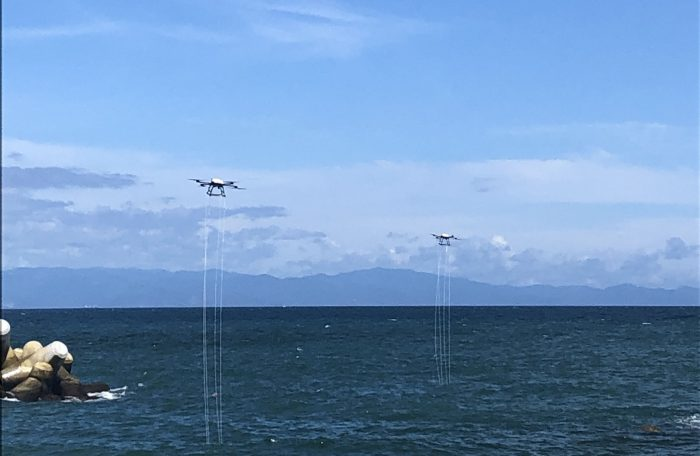
PRODRONE aircraft flying during this research. PD6B-Type2
PRODRONE Co., Ltd. (hereinafter referred to as PRODRONE) cooperated in the ``Joint Research on Demonstration of UAV as a Sea Surface Communication Base with AUV etc.'' (hereinafter referred to as this research) conducted in June 2021.
This research is led by Associate Professor Yusuke Yokota of the Undersea Observation Implementation Research Center, Institute of Industrial Science, the University of Tokyo, and Full-time Lecturer Takumi Matsuda of the Faculty of Science and Engineering, Meiji University. We aim to improve work efficiency and agile operation by combining autonomous underwater and seabed observation equipment such as vehicles.
Currently, underwater and seabed observations use ships as offshore bases, and AUVs released from the ships communicate with the ships using acoustic communication. The large cost and lack of mobility have been issues in operating ships, but the solution to these issues is the use of drones as maritime bases. Drones are expected to be superior to ships in terms of maneuverability, fuel efficiency, operational structure, efficiency, etc. However, there was still an overwhelming lack of proven cases.
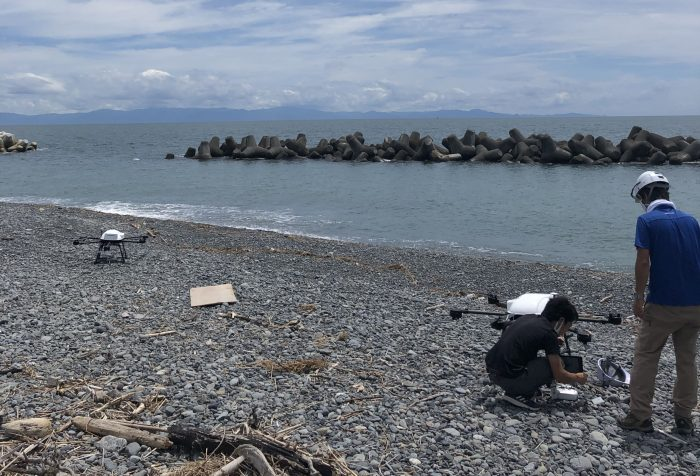
Situation during this research
Against this background, this research group led by Associate Professor Yokota of the University of Tokyo and Full-time Lecturer Matsuda of Meiji University has been conducting demonstrations using drones, such as lingering on the sea surface to perform measurements like a buoy, and investigating the possibility of underwater measurements. As a further development of this research, we conducted a demonstration test in which a drone is used as a base on the sea and used as a mother ship for underwater and submarine observation equipment such as AUVs.
For devices such as AUVs that autonomously survey the ocean and the seabed, it is important not only to have position detection performance, but also to have the ability to communicate with offshore bases.In this research, we not only confirmed the expected maneuverability and cost effectiveness, but also confirmed that drones can communicate with each other in coastal areas, and communication over a distance of approximately 200 meters has been achieved.
Furthermore, various advantages were confirmed, such as less underwater acoustic noise compared to ships, demonstrating the great potential of using drones for underwater and seabed surveys in coastal areas. Important future research issues include the development of drones and power sources that can operate for long periods of time, as well as reducing the weight of observation equipment carried by drones, and PRODRONE plans to continue to cooperate in demonstrations.
■Observation video (YouTube)
■For experiment details, please refer to here Please see the University of Tokyo presentation materials.
This article has been automatically translated into English using AI. The original content is written in Japanese. While we strive for accuracy, the translation may not fully capture the nuance of the original.
Related News
Establishment of Prodrone's First Mass Production Plant within Howa Machinery - Notice Regarding Third-Party Allotment of Shares with the Company as the Subscriber -