Announcement of the “Sovereign AI” Concept, Featuring a Multi-Agent GCS and Edge VLA in the Purely Domestic “SAMURAI TECH by Prodrone”
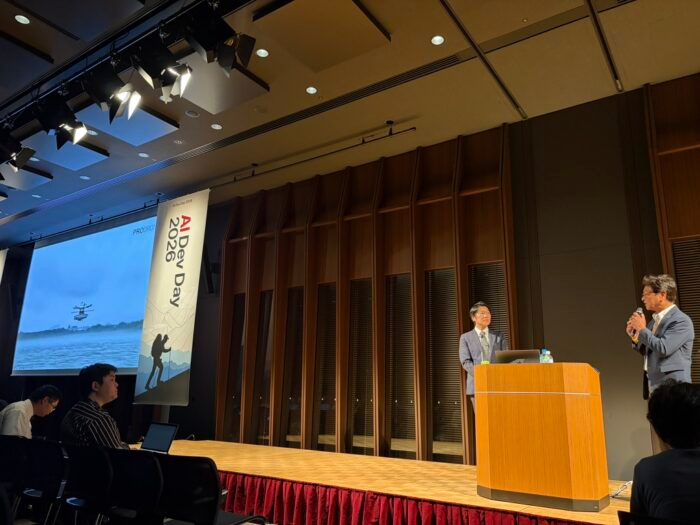
Kiyoichi Sugaki (right in photo) and Masato Ito (left in photo) took the stage for the keynote at AI Dev Day 2026
Prodrone Co., Ltd. (Headquarters: Nagoya, Aichi Prefecture; President and CEO: Shunsuke Toya; hereinafter “Prodrone”) announced a new concept for an autonomous flight and operations management system (hereinafter “this concept”) utilizing generative AI and edge VLA (Vision-Language-Action models) during the keynote session at “AI Dev Day 2026,” held on July 24, 2026. This announcement is part of the company’s efforts to develop “SAMURAI TECH by Prodrone,” a next-generation, entirely domestically produced drone.
The announcement detailed a concept for a next-generation autonomous flight and operations management system that utilizes generative AI and edge VLA (Vision-Language-Action models). It aims to move beyond the conventional model of “manual piloting by specialized pilots” and realize “a world where humans and AI collaborate—where a higher-level system translates objectives communicated verbally by humans into specific missions, and the drone optimally executes them on-site.”
Currently, operational settings such as beyond-visual-line-of-sight (Level 4) flights for disaster surveys and infrastructure inspections require multiple specialized personnel—including pilots, flight supervisors, filming and measurement operators, and regulatory compliance officers—to be present simultaneously. Severe labor shortages and high training costs pose significant barriers to widespread adoption. Prodrone aims to overcome this “reliance on human expertise” through the use of AI and to build social infrastructure that enables anyone to operate drones safely and reliably.
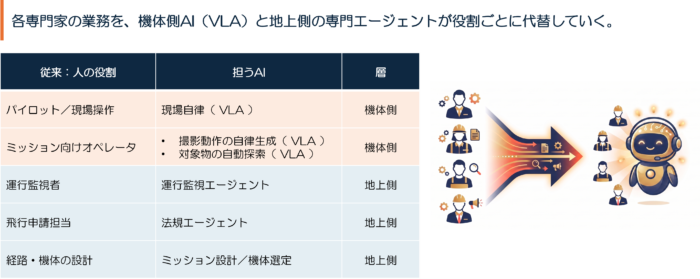
A Two-Layer AI System Takes Over Experts’ Tasks
The main technical features of this concept are as follows.
(1) Aircraft Side: Real-Time Autonomous Decision-Making on-Site via Edge VLA
The aircraft (edge) will be equipped with a VLA (Vision-Language-Action) model that integrates vision, language, and action. Upon receiving an abstract instruction from the ground—such as “Inspect this transmission tower”—the drone will analyze various sensor data (images, LiDAR, wind speed, etc.) in real time and autonomously generate the safest and most optimal flight path and camera controls (control codes) on-site. Since detailed manual operation of each drone is no longer necessary, a “one-to-many” operation is realized, where a single operator manages multiple drones in coordination with a ground-based multi-agent system.
(2) Ground Side: Voice Interaction via Multi-Agent GCS
A multi-agent system capable of interacting with humans in natural language will be implemented in the ground-based GCS (Ground Control Station). Simply by having an operations supervisor convey what they “want to do” or the objective they wish to achieve (e.g., “Please conduct a river flood survey”) via voice or other means, the core AI (orchestrator) plans the tasks necessary for the mission. It then automatically plans everything from selecting the optimal aircraft, verifying weather and local regulations, submitting flight applications, to designing flight routes—all while orchestrating (coordinating) multiple specialized agents. Furthermore, to ensure safety, we strictly adhere to a “Human-in-the-loop” design that applies clear rule-based systems and requires humans to make the final decisions.
Moreover, this concept is not merely theoretical; the implementation of the underlying technologies is already underway at the field level. Functions that detect and track objects and relay the results to higher-level systems in real time are already operational at the practical level. We have completed a proof of concept (PoC) for tracking inspections of power lines and rail tracks, which directly contributes to the automation of infrastructure inspections. Furthermore, in May 2026, we demonstrated—using a simulator—the entire process from planning initial disaster response missions to launching the aircraft using voice commands alone.
[Video URL] Demonstration of Voice Commands and Autonomous Flight Using the Multi-Agent GCS
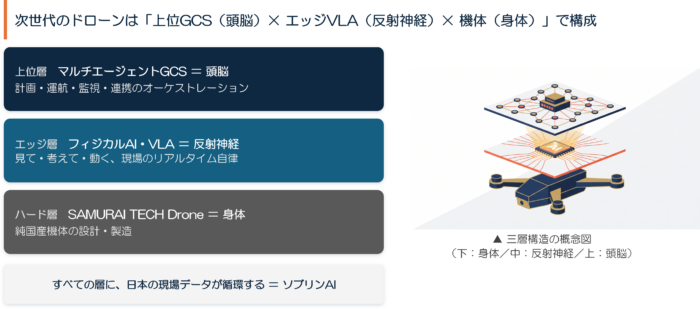
Prodrone’s Vision for an Integrated Drone System
In this vision, “Sovereign AI” refers to an approach that actively leverages a globally developed ecosystem of advanced cloud infrastructure and inference chips, while retaining and managing “decision-making sovereignty,” “on-site data from Japan,” and “expertise in physical control” domestically (within the company).
In the autonomous operation of drones, it is crucial for the company and the operator to firmly maintain sovereignty over on-site real-time decision-making, the management of acquired data, and the physical control (flight) of the aircraft. By training the system with the “correct data for safe flight”—gained through Prodrone’s more than 30 years of experience in the design, manufacture, and demonstration of helicopters and drones—we will build a highly reliable AI system optimized for Japan’s airspace and regulations.
Aiming to create a neutral, open platform that transcends manufacturer boundaries, Prodrone will work with co-creation partners—including AI platform model developers, operators with on-site field operations, and development partners—toward the societal implementation of this system. Together, we will evolve drones from a tool used by a select few experts into an open infrastructure that supports society as a whole.
[About AI Dev Day 2026]
Official Event URL: https://aidevday.com/
[About Prodrone Co., Ltd.]
With the vision of “becoming the most trusted drone company in the region,” we aim to build a drone ecosystem in the Chubu region. We provide one-stop services ranging from development to production of industrial drones, including the “PD6B-Type3” multicopter—which has a maximum recommended payload of 20 kg and is now in mass production—and the “Prodrone GT-M,” capable of long-distance flight (tested up to 100 km).
This article has been automatically translated into English using AI. The original content is written in Japanese. While we strive for accuracy, the translation may not fully capture the nuance of the original.
Related News
Establishment of Prodrone's First Mass Production Plant within Howa Machinery - Notice Regarding Third-Party Allotment of Shares with the Company as the Subscriber -